Lavender Colored Flowers and the Butterfly

There a lot of flowers we see around everytime we go walking! One day as we went walking, we found these lavender colored flowers. It has a visitor, this beautiful creature called butterfly. Isn’t this a real beauty of nature? have fun viewing and have a great day! appreciate if you could share the name of these wild flowers! thanks in advance!

copyright photo by the Authors of this site
 

Gerbera or Daisy Flowers

We don’t have a Gerbera or Daisy flowers at this time. The one in the photo here are also taken as we went to the garden center around 25 minutes drive from us.

Gerbera (pronounced /ˈɡɜrbərə/) L. is a genus of ornamental plants from the sunflower family (Asteraceae). It was named in honor of the German naturalist Traugott Gerber, a friend of Carolus Linnaeus.

It has approximately 30 species in the wild, extending to South America, Africa and tropical Asia. The first scientific description of a Gerbera was made by J.D. Hooker in Curtis’s Botanical Magazine in 1889 when he described Gerbera jamesonii, a South African species also known as Transvaal daisy or Barberton Daisy.

Gerbera species bear a large capitulum with striking, two-lipped ray florets in yellow, orange, white, pink or red colors. The capitulum, which has the appearance of a single flower, is actually composed of hundreds of individual flowers. The morphology of the flowers varies depending on their position in the capitulum. The flowers can be as small as 7 cm (Gerbera mini ‘Harley’) in diameter or up to 12 cm (Gerbera ‘Golden Serena’). continue reading here

Scientific classification:

Kingdom: Plantae
(unranked): Angiosperms
(unranked): Eudicots
(unranked): Asterids
Order: Asterales
Family: Asteraceae
Subfamily: Mutisioideae
Tribe: Mutisieae
Genus: Gerbera


Flamingo Flowers or Anthurium

We are back to give you some flower update! We have here a pink Anthurium also known as Flamingo flowers or Bloy Flower. We took this photo during our visit to the garden center last week. Anthurium belongs to Arum family or Araceae. Most Anthurium flowers can be grown indoor and outdoor in mild climates with shady spots. These are another beautiful kind of flowers!

Scientific classification:

Kingdom: Plantae
(unranked): Angiosperms
(unranked): Monocots
Order: Alismatales
Family: Araceae
Tribe: Anthurieae
Genus: Anthurium


Glamorous Phalaenopsis Orchid

A kind of orchid that I always love, the Phalaenopsis. Another photo we took at the garden center. We already have two colours of this kind of orchids at home. We wish to share it once the photos are already uploaded. This kind of orchid is one of the most popular in its kind. Sometimes we wonder how these beautiful creature came into existence..or probably the law of nature created it. But we believed that there is someone who is in charge of creating it, no other than the Creator of the Universe. have fun viewing this glamorous creature!

Scientific classification:

Kingdom: Plantae
(unranked): Angiosperms
(unranked): Monocots
Order: Asparagales
Family: Orchidaceae
Subfamily: Epidendroideae
Tribe: Vandeae
Subtribe: Aeridinae
Alliance: Phalaenopsis
Blume
Genus: Phalaenopsis


I was surprised reading in the wikipedia that most of the Medinilla plants are endemic in the Philippines. These are lovely flowers which we also had before in our garden. here is a photo of Medinilla and a little information about it from wikipedia.

Medinilla is a genus of about 150 species of flowering plants in the family Melastomataceae, native to tropical regions of the Old World from Africa (two species) east through Madagascar (about 70 species) and southern Asia to the western Pacific Ocean islands. The genus was named after J. de Medinilla, governor of the Mariana Islands in 1820.

They are evergreen shrubs or lianas. The leaves are opposite or whorled, or alternate in some species. The flowers are white or pink, produced in large panicles.

Medinilla magnifica is a popular ornamental plant endemic to Luzon, one of the main islands in the Philippines.

Scientific classification
Kingdom: Plantae
Division: Magnoliophyta
Class: Magnoliopsida
Order: Myrtales
Family: Melastomataceae
Genus: Medinilla


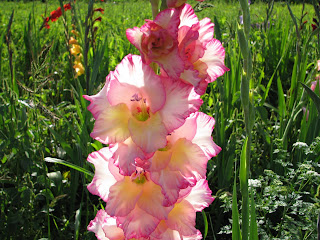
Beautiful Varigated Gladiola or Gladiolus

These are very beautiful varigated Gladiolus or Gladiola. It has a variation of white and pink colours. We just happened to pass-by in this garden somewhere in Beilgries, Bavaria. My wife told me to stop the cars as she saw the gladiola garden along the road…very beautiful! keep reading below for general information about these lovely flowers.

Gladiolus (from Latin, the diminutive of gladius, a sword) is a genus of perennial bulbous flowering plants in the iris family (Iridaceae). Sometimes called the sword lily, the most widely-used English common name for these plants is simply gladiolus (plural gladioli, gladioluses or sometimes gladiolas).

The genus is distributed in Mediterranean Europe, Asia, Tropical Africa and South Africa. However, the center of diversity of the genus is located in the Cape Floristic Region, where most species were discovered. As a matter of fact, 163 out of the 250 species of Gladiolus are from Southern africa. The genera Oenostachys, Homoglossum, Anomalesia and Acidanthera, traditionally considered independent entities, currently are included in Gladiolus.
Scientific classification

Kingdom: Plantae
(unranked): Angiosperms
(unranked): Monocots
Order: Asparagales
Family: Iridaceae
Subfamily: Ixioideae
Tribe: Ixieae
Genus: Gladiolus

DESCRIPTION

The genus Gladiolus contains about 260 species, of which 250 are native to sub-Saharan Africa, mostly South Africa. About 10 species are native to Eurasia. There are 160 species of Gladiolus endemic in southern Africa and 76 in tropical Africa. The species vary from very small to the spectacular giant flower spikes in commerce.

These attractive, perennial herbs are semihardy in temperate climates. They grow from rounded, symmetrical corms, that are enveloped in several layers of brownish, fibrous tunics.

Their stems are generally unbranched, producing 1 to 9 narrow, sword-shaped, longitudinal grooved leaves, enclosed in a sheath. The lowest leaf is shortened to a cataphyll. The leaf blades can be plane or cruciform in cross section.

The fragrant flower spikes are large and one-sided, with secund, bisexual flowers, each subtended by 2 leathery, green bracts. The sepals and the petals are almost identical in appearance, and are termed tepals. They are united at their base into a tube-shaped structure. The dorsal tepal is the largest, arching over the three stamens. The outer three tepals are narrower. The perianth is funnel-shaped, with the stamens attached to its base. The style has three filiform, spoon-shaped branches, each expanding towards the apex.

The ovary is 3-locular with oblong or globose capsules, containing many, winged brown, longitudinally dehiscent seeds. In their center must be noticeable the specific pellet like structure which is the real seed without the fine coat. In some seeds this structure is wrinkled and with black color. These seeds are unable to germinate.

These flowers are variously colored, pink to reddish or light purple with white, contrasting markings, or white to cream or orange to red.

The South African species were originally pollinated by long-tongued anthrophorine bees, but some changes in the pollination system have occurred, allowing pollination by sunbirds, noctuid and sphingid moths, long-tongued flies and several others. In the temperate zones of Europe many of the hybrid large flowering sorts of gladiolas can be pollinated by small well-known wasps. Actually, They are not very good pollinators because of the large flowers of the plants and the small size of the wasps. Another insect in this zone which can try some of the nectar of the gladioli is the best-known European Hawk-moth Macroglossum stellatarum which usually pollinates many famous garden flowers like Petunia, Zinnia, Dianthus and others.

Gladioli are used as food plants by the larvae of some Lepidoptera species including the Large Yellow Underwing.

Gladioli have been extensively hybridized and a wide range of ornamental flower colours are available from the many varieties. The main hybrid groups have been obtained by crossing between four or five species, followed by selection: Grandiflorus, Primulines and Nanus. They make very good cut flowers. However, due to their height, the cultivated forms frequently tend to fall over in the wind if left on the plant. wikipedia


Beautiful Petunia Flowers

Isn’t this a blue violet color? No matter what we still love these flowers and we have some in our garden. I just research online about these flowers and I found out its categories below. Thanks to the experts of wikipedia for sharing it.

“CATEGORIES OF PETUNIA

Grandiflora

This type of petunias has the largest flowers, up to 4 inches in diameter. Of all the petunias these have the widest variety of forms and colors but are the most likely to be damaged by heavy rain. There are four types of grandiflora and they are classified by their colors, namely, ‘Daddy Series’ (shades of pink and purple), ‘Merlin Blue Morn’ (blue and white), ‘Supercascade Series’ (many colors) and ‘Ultra Series’ (many colors including bicolor).

Spreading

Spreading petunias (sometimes called groundcover) are characterized by their low height (usually about six inches), but a large spread (about three to four feet). They will cover a large area provided they have adequate water and fertilization. ‘Purple Wave’ was the first introduced cultivar of spreading petunias and grows to a height of 4 inches. ‘Tidal Wave’ is another spreading type of petunia, but is much taller (between sixteen and twenty two inches). ‘Opera Supreme’ is a cultivar with large flowers.

Mulitflora

Multiflora, when compared to grandiflora are half the size, 2 inches in diameter, they are not easily damaged in heavy rain and can tolerate more sun. Multiflora petunias cultivars include: ‘Carpet Series’ (many colors), ‘Surfinia Series’ (pink, blue, purple and white), and ‘Wave Series’ (pink, coral and purple). These spread quickly and are ideal for hanging baskets.

Milliflora

Milliflora are the smallest of the petunias and about 1 inch across. These are prettiest when mixed with other plants in containers, along garden beds, and edges. Milliflora are available in ‘Fantasy Series’ (red, purple, pink) and are the easiest to find. ‘Supertunia Mini Series’ (blue, pink, lilac, purple and white)are also available in the milliflora catagory. They tolerate harsh weather better when compared to grandifloras and multifloras.

Scientific classification

Kingdom: Plantae
(unranked): Angiosperms
(unranked): Eudicots
(unranked): Asterids
Order: Solanales
Family: Solanaceae
Genus: Petunia


Beautiful Orange Flowers

Me and my wife had a sightseeing last weekend. One of the place we visited was the Garden of Willibald Castle in Eichstaett, a city in Bavaria, Germany. It was an amazing garden full of lovely flowers and plants. I took this photo of a beautiful orange flowers below. Any idea about its name. Thanks in advance for the information.


The Butterfly and the Flower

Natures are truly beautiful! No matter what, its Creator is truly magnificent! Here is a very nice shot of the butterfly on top of the flower. He seems to enjoy sipping the flowers. Me and my wife had a visit last time in Landesgartenschau or City Garden in Neumarkt. This is not professionally taken but I still love the outcome. Any idea about the name of these flowers? thanks in advance!


Smallest Gladiola in the World

I read before in the internet and also saw some pictures that the Gladiola or Gladiolus that I have in the picture below is the smallest kind of gladiola in the world. I just forgot its exact name. I hope I can find it next time and share it here. I guess we are lucky to grow some in our garden. There hundreds of varieties of this kind of flower. We had some other kinds before but they did not grew back this year again. Probably they are rotten under the ground. here is a photo of this lovely flowers.
Gladiolus (from Latin, the diminutive of gladius, a sword) is a genus of perennial bulbous flowering plants in the iris family (Iridaceae). Sometimes called the sword lily, the most widely-used English common name for these plants is simply gladiolus (plural gladioli, gladioluses or sometimes gladiolas).

The genus is distributed in Mediterranean Europe, Asia, Tropical Africa and South Africa. However, the center of diversity of the genus is located in the Cape Floristic Region, where most species were discovered. As a matter of fact, 163 out of the 250 species of Gladiolus are from Southern africa. The genera Oenostachys, Homoglossum, Anomalesia and Acidanthera, traditionally considered independent entities, currently are included in Gladiolus.


Resources

Hi dear friends and visitors!! thanks for visiting me here!! Have a great and blessed day!!


WANT TO EXCHANGE LINK WITH ME? READ HERE FIRST

Extras

All photographs used on this site, including thumbnails, are the Author's property and are ©copyright. Please do not use our photos without our permission. If you wish to use one of our photos on your personal website or blog, please send us the link to the page where it is being used and the photo must be linked back to this site. We hope that you respect the Authors' request. Thank you for your respect and understanding!

Copyright © 2013 Health, Food and Travel | All Rights Reserved

Blog Design by Simple Blog MakeOver