July 21st, 2009 by admin
The Authors of this site are not expert gardeners. We just love gardening and love to plant fruits, plants and flowers. We have some in our garden but not all. We have been looking and buying for perennial plants the past weeks. We just need these kind of plants so that they will grow again after winter time. To have more idea about these plants, we consulted the experts from wikipedia about this. This is also for general information if ever you are searching for this kind of plants.
“A perennial plant or perennial (Latin per, “through”, annus, “year”) is a plant that lives for more than two years. When used by gardeners or horticulturalists, this term applies specifically to perennial herbaceous plants. Scientifically, woody plants like shrubs and trees are also perennial in their habit.
Perennials, especially small flowering plants, grow and bloom over the spring and summer and then die back every autumn and winter, then return in the spring from their root-stock rather than seeding themselves as an annual plant does. These are known as herbaceous perennials. However, depending on the rigors of local climate, a plant that is a perennial in its native habitat, or in a milder garden, may be treated by a gardener as an annual and planted out every year, from seed, from cuttings or from divisions.
LIFE CYCLE
Perennial plants can be short-lived (only a few years) or they can be long-lived, as are some woody plants like trees which can live for over 3,000 years. They can vary in height from only a few millimeters to over 100 meters tall. They include a wide assortment of plant groups from ferns and liverworts to the highly diverse flowering plants like Orchids and Grasses.
Plants that flower and fruit only once and then die are termed monocarpic or semelparous. However, most perennials are polycarpic, flowering over many seasons in their lifetime.
July 13th, 2009 by admin
Me and my wife visited yesterday the Landesgartenschau or City Garden in Neumarkt. We had fun going around while taking pictures of the different flowers, bushes and trees and at the same time enjoying the scenery of nature. It was a very beautiful day. We have a blue violet flower here. We need you help to indentify this. We are not sure if this is called Syringa or Flieder Blumen in German. any idea out there?..Thanks in advance!
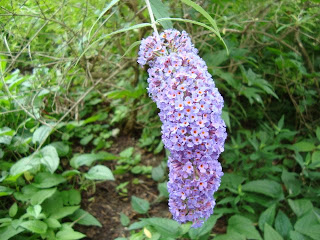 Thanks to Gracieanne for sharing the name of this flower..It is called Lilac or Flieder in German. Tried to visit you Gracieanne but it seems that you profile is private.
July 12th, 2009 by admin
These are called daisy flowers. In some languages like Spanish, it is called Margarita and they belong to the family Asteraceae or Compositae. Flowers are always wonderful!
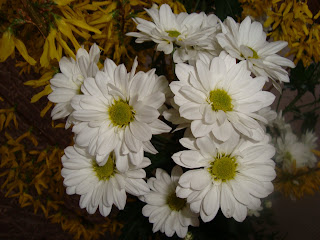
The family Asteraceae or Compositae (known as the aster, daisy, or sunflower family) is the second largest family of flowering plants, in terms of number of species.
The name Asteraceae is derived from the type genus Aster, while Compositae, an older but still valid name, means composite and refers to the characteristic inflorescence, a special type of pseudanthium found in only a few other angiosperm families. The study of this family is known as synantherology.
According to the Royal Botanic Gardens of Kew, the family comprises more than 1,600 genera and 23,000 species. The largest genera are Senecio (1,500 species), Vernonia (1,000 species), Cousinia (600 species), Centaurea (600 species). The circumscription of the genera is often problematic and some of these have been frequently divided into minor subgroups.
Asteraceae are cosmopolitan, but most common in the temperate regions and tropical mountains. http://en.wikipedia.org/wiki/Asteraceae
July 10th, 2009 by admin
The flowers you see in the header of this site are the same tulips in our garden. The one in the header was taken last year. The salmon-coloured tulips you see in the picture below were the ones that grew this year. These tulips were gone now. What we have are photos from them. We hope to see them again next year. I love these flowers! more photos to share next time!

“The species are perennials from bulbs, the tunicate bulbs often produced on the ends of stolons and covered with hairless to variously hairy papery coverings. The species include short low-growing plants to tall upright plants, growing from 10 to 70 centimeters (4–27 in) tall. They can even grow in the cold and snowy winter. Plants typically have 2 to 6 leaves, with some species having up to 12 leaves. The cauline foliage is strap-shaped, waxy-coated, usually light to medium green and alternately arranged. The blades are somewhat fleshy and linear to oblong in shape. The large flowers are produced on scapes or subscapose stems normally lacking bracts. The stems have no leaves to a few leaves, with large species having some leaves and smaller species have none. Typically species have one flower per stem but a few species have up to four flowers. The colourful and attractive cup shaped flowers typically have three petals and three sepals, which are most often termed tepals because they are nearly identical. The six petaloid tepals are often marked near the bases with darker markings. The flowers have six basifixed, distinct stamens with filaments shorter than the tepals and the stigmas are districtly 3-lobed. The ovaries are superior with three chambers. The 3 angled fruits are leathery textured capsules, ellipsoid to subglobose in shape, containing numerous flat disc-shaped seeds in two rows per locule. http://en.wikipedia.org/wiki/Tulips
July 8th, 2009 by admin
Primula flowers are one of the flowers we saw in spring time. The one we have here was taken somewhere down a tree near our doctor’s clinic. Primula comes from a Latin word which means first or prime and are among the flowers to open first in spring time. I already saw different colors or primula from yellow to red, purple, pink or white. These are very lovely flowers!

July 7th, 2009 by admin
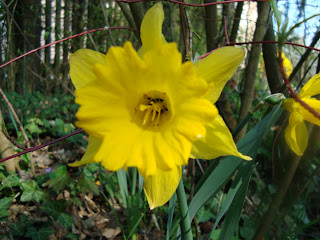
I got here a very beautiful Narcisus. This was taken in the garden of our doctor’s clinic. I just can’t stop to click my camera as I saw this..beautiful flower indeed!
“All Narcissus species have a central trumpet-, bowl-, or disc-shaped corona surrounded by a ring of six floral leaves called the perianth which is united into a tube at the forward edge of the 3-locular ovary. The seeds are black, round and swollen with hard coat. The three outer segments are sepals, and the three inner segments are petals. Though the traditional daffodil of folklore, poetry, and field may have a yellow to golden-yellow color all over, both in the wild species and due to breeding, the perianth and corona may be variously colored. Breeders have developed some daffodils with double, triple, or ambiguously multiple rows and layers of segments, and several wild species also have known double variants. wikipedia
Scientific Classification:
Kingdom: Plantae
(unranked): Angiosperms
(unranked): Monocots
Order: Asparagales
Family: Amaryllidaceae
Genus: Narcissus
July 6th, 2009 by admin
We need you help right now! Anybody know the name of these wild lavender flowers? We saw them as we went walking in the wilderness yesterday. They just caught our attention. Since we always have handy cameras on hand, we took a photo from this lovely creatures!
We greatly appreciate your information about these flowers!

July 4th, 2009 by admin
These are the first flowers of our Red Petunia. We love these flowers because they always bloom the whole summer. Sad to say, they don’t come back every year. They die during winter time. We always buy these flowers every year! they are simply beautiful!

Scientific Classification
Kingdom: Plantae
(unranked): Angiosperms
(unranked): Eudicots
(unranked): Asterids
Order: Solanales
Family: Solanaceae
Genus: Petunia
July 3rd, 2009 by admin
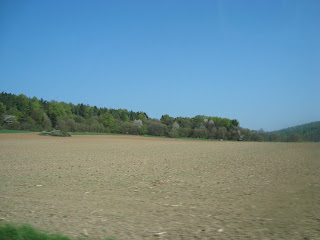
Do you love seeing the beauty of nature around us? Do you love to watch the sky and marvel in its vastness and beauty? We always appreciate the beauty of nature even the wild flowers we see in the wilderness. We hope that we will also take care of our Mother Earth by taking care of our nature. Here is a blue sky for you to see. This photo was taken from the sky somewhere in Bavaria, Germany. The farmers are already preparing their field to plant for something. Have a nice day to all!
July 1st, 2009 by admin
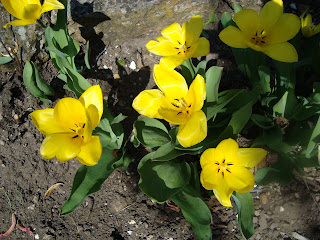
Tulips time is over! These yellow tulips are also gone from our garden. They usually grow in the months of March to April. We got different colours of these flowers. Try to search and dig this blog for more tulips photos. We hope that you enjoy viewing this blog!