Lovely Narcissus jonquilla.

We found these flowers as we visited our doctor last April of this year. There is a garden on the side of the clinic and I took a photo of it! Lovely flowers!

Characteristics of Narcissus jonquilla and its allies clearly evident; flowers are small to medium sized, perianth segments are flat, corona length varies but is usually short and semi-spherical, foliage may be rush-like and dark green as in the species but phenotypic distillation through crossbreeding between divisions has produced a range of foliage types. Fragrance is usually prominent. Flowers may be borne one to several to a stem, depending upon cultivar.


Christ Plant or Crown of Thorns or Euphorbia Milli

I have here a Christ Plant or Crown of Thorns or Euphorbia Milli flowers. I miss the big Euphorbia flowers in my garden back home. Now I have the small flowers in our house. This plant is very easy to grow. It don’t requires too much watering. It can stand the heat. I have two colors now, the pink and red ones.

copyright photo by: Euronics

Scientific Classification

Kingdom: Plantae
Division: Magnoliophyta
Class: Magnoliopsida
Order: Malpighiales
Family: Euphorbiaceae
Genus: Euphorbia
Species: E. milii

Euphorbia milii (Crown-of-thorns or Christ Plant) is a species of Euphorbia native to Madagascar.

It is a succulent climbing shrub growing to 1.8 m tall, with densely spiny stems, the straight, slender spines up to 3 cm long, which help it scramble over other plants. The leaves are obovate, up to 3.5 cm long and 1.5 cm broad. The flowers are small, subtended by a pair of conspicuous petal-like bracts, variably red, pink or white, up to 12 mm broad.[1] Wat Phrik in the Phitsanulok District of Phitsanulok Province, Thailand claims to be the home of the world’s tallest Christ plant.


Pelargonium or Red Geranium in Our Garden

As I bought this red geranium, there was a name on the flower pot that says it’s name as Geranien. It is a German word which simply means in English Geranium. I always buy these flowers ever year. Now I found out that there are other kinds of geranium that are winter hard. It means that they will survive the winter and will come back in the next spring time. I want to buy those winter hard geranium, the nest I will go to the garden center. This flower is also called Pelargonium…very interesting! I got here a photo of Red Geranium fresh from our garden!

copyright photo by: Euronics

Scientific Classification:

Kingdom: Plantae
Division: Magnoliophyta
Class: Magnoliopsida
Order: Geraniales
Family: Geraniaceae
Genus: Pelargonium


Pelargonium is a genus of flowering plants which includes about 200 species of perennials, succulents, and shrubs, commonly known as geraniums or storksbills. Confusingly, Geranium is the correct botanical name of a separate genus of related plants often called Cranesbills. Both genera are in the Family Geraniaceae. Linnaeus originally included all the species in one genus, Geranium, but they were later separated into two genera by Charles L’Héritier in 1789. Gardeners sometimes refer to the members of Genus Pelargonium as “pelargoniums” in order to avoid the confusion, but the older common name “geranium” is still in regular use.


Red Begonia Flowers in Our Garden

I have different colors of Begonia flowers in our garden. I guess my favorite are the red one. These flowers are not greedy in giving flowers. See how one whole plant is giving a lot of beautiful red flowers..very lovely!

Scientific Classification:

Kingdom: Plantae
Division: Magnoliophyta
Class: Magnoliopsida
Order: Cucurbitales
Family: Begoniaceae
Genus: Begonia
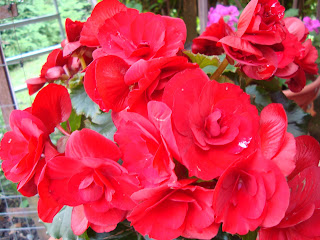
copyright photo by: Euronics

Begonia is a genus in the flowering plant family Begoniaceae. The only other member of the family Begoniaceae is Hillebrandia, a genus with a single species in the Hawaiian Islands. The genus Symbegonia is now included in Begonia. “Begonia” is the common name as well as the generic name for all members of the genus.

The genus name coined by Charles Plumier French patron of botany honours Michel Bégon, a former governor of the French colony of Haiti.

DESCRIPTION
With over 1,500 species, Begonia is one of the ten largest angiosperm genera. The species are terrestrial (sometimes epiphytic) herbs or undershrubs and occur in subtropical and tropical moist climates, in South and Central America, Africa and southern Asia. Terrestrial species in the wild are commonly upright-stemmed, rhizomatous, or tuberous. The plants are monoecious, with unisexual male and female flowers occurring separately on the same plant, the male containing numerous stamens, the female having a large inferior ovary and two to four branched or twisted stigmas. In most species the fruit is a winged capsule containing numerous minute seeds, although baccate fruits are also known. The leaves, which are often large and variously marked or variegated, are usually asymmetric (unequal-sided).

Because of their sometimes showy flowers of white, pink, scarlet or yellow color and often attractively marked leaves, many species and innumerable hybrids and cultivars are cultivated. The genus is unusual in that species throughout the genus, even those coming from different continents, can frequently be hybridized with each other, and this has led to an enormous number of cultivars. The American Begonia Society classifies begonias into several major groups: cane-like, shrub-like, tuberous, rhizomatous, semperflorens, rex, trailing-scandent, or thick-stemmed. For the most part these groups do not correspond to any formal taxonomic groupings or phylogeny and many species and hybrids have characteristics of more than one group, or fit well into none of them. source: wikipedia


Flamingo Flowers or Anthurium

I grow Flamingo flowers of Anthurium in our garden before. Now I don’t have it anymore. I took a photo of it as we visited a garden center last time. This is a very beautiful flower!

Scientific Clarification
Kingdom: Plantae
(unranked): Angiosperms
(unranked): Monocots
Order: Alismatales
Family: Araceae
Tribe: Anthurieae
Genus: Anthurium


Anthurium (pronounced /ænˈθjuːriəm/) (Schott, 1829), is a large genus of about 600- 800 (possibly 1,000) species, belonging to the arum family (Araceae). Anthurium can also be called “Flamingo Flower” or “Boy Flower”, both referring to the structure of the spathe and spadix.

TROPICOS lists 1901 types, although some of these are duplicates. It is one of the largest and probably the most complex genus of this family; certainly it is one of the most variable. Many species are undoubtedly not yet described and new ones are being found every year. The species has neotropical distribution; mostly in wet tropical mountain forest of Central America and South America, but some in semi-arid environments. Most species occur in Panama, Colombia, Brazil, the Guiana Shield and Ecuador. According to the work of noted aroid botanist Dr. Tom Croat of the Missouri Botanical Garden, this genus is not found in Asia. Some species have been introduced into Asian rain forests, but are not endemic. source: wikipedia


Beautiful Sunflower

We don’t plant sunflower in our garden this year. The last time we planted it was three years ago. Hopefully next year, we can plant some.

Description of Sunflower
What is usually called the flower is actually a head (formally composite flower) of numerous florets (small flowers) crowded together. The outer florets are the sterile ray florets and can be yellow, maroon, orange, or other colors. The florets inside the circular head are called disc florets, which mature into what are traditionally called “sunflower seeds,” but are actually the fruit (an achene) of the plant. The inedible husk is the wall of the fruit and the true seed lies within the kernel.

The florets within the sunflower’s cluster are arranged in a spiral pattern. Typically each floret is oriented toward the next by approximately the golden angle, 137.5°, producing a pattern of interconnecting spirals where the number of left spirals and the number of right spirals are successive Fibonacci numbers. Typically, there are 34 spirals in one direction and 55 in the other; on a very large sunflower there could be 89 in one direction and 144 in the other. This pattern produces the most efficient packing of seeds within the flower head.

I took this photo as we visited a garden center this month.

Kingdom: Plantae
(unranked): Angiosperms
(unranked): Eudicots
(unranked): Asterids
Order: Asterales
Family: Asteraceae
Subfamily: Helianthoideae
Tribe: Heliantheae
Genus: Helianthus
Species: H. annuus
Binomial name:
Helianthus annuus
 

Tiger Lilies in Our Garden

We have different colors of Lilies in our garden. The orange tiger lilies are still blooming until now. The yellow colored ones are slowly fading now. I bought another colors but still don’t know its colors until it will bloom..hopefully next week. I hope that they are pink and white this time. here are the tiger lilies in our garden! they wet as I took the photos.

The genus Lilium are herbaceous flowering plants growing from bulbs. They comprise a genus of about 110 species in the lily family, Liliaceae. They are important as large showy flowering garden plants. They are important culturally and in literature in much of the world.

Some species are sometimes grown or harvested for the edible bulbs.

The species in this genus are the true lilies. Many other plants exist with “lily” in the common English name, some of which are quite unrelated to the true lilies.


Gloxinia- Sinningia Hybrid

Sinningia (pronounced /sɨˈnɪndʒiə/) is a genus of flowering plants in the family Gesneriaceae. There are about 65 species of tuberous perennial herbs, all occurring in Central America and South America, with the greatest concentration of species occurring in southern Brazil.

I have here a photo which I took in a garden center. I love the color of these flowers! awesome!

The best-known species, Sinningia speciosa, was originally introduced to cultivation as Gloxinia speciosa and is still commonly known to gardeners and in the horticultural trade as “gloxinia”. The true genus Gloxinia is distinguished by having scaly rhizomes rather than tubers.

Sinningia species often grow on rocks or cliffs and most are pollinated by hummingbirds or bees but Sinningia brasiliensis is bat-pollinated, and Sinningia tubiflora, with large, powerfully fragrant tubular white flowers, is apparently pollinated by sphinx moths. Most of the species have large, brightly colored flowers because of this, numerous species and a large number of hybrids and cultivars are cultivated as houseplants. Some species with particularly large tubers are cultivated by cactus and succulent enthusiasts as caudiciforms. One such example is Sinningia leucotricha, often listed under the older name Rechsteineria leucotricha and dubbed “Brazilian edelweiss” for its covering of silvery, silky hairs. Other species with large tubers are Sinningia iarae, Sinningia lineata, and Sinningia macropoda.

The Brazilian genera Paliavana and Vanhouttea, consisting of shrubby plants without tubers, are closely related to Sinningia and recent morphological and molecular analyses (Boggan 1991, Perret et al. 2003) suggest that these genera are, in fact, nontuberous Sinningia species. All three genera were included in tribe Gloxinieae in the classification system of Hans Wiehler but are now recognized in their own tribe, Sinningieae.
Sinningia speciosa, flower about 5 cm across

Numerous genera, including Corytholoma, Rechsteineria and Lietzia, have been synonymized under Sinningia. source: wikipedia


Rhododendron or Azalea Bush

Sometimes I am confused with the different names of a certain flower. Just like this rhododendron flowers. I was trying to find the flower cut-outs that I collected in newspapers or flyers to know the name of the flowers in our garden or flowers that I see in the neighborhood. I finally find the name of this flower. I was just not sure if it is really the right one..Now I finally found it..It is Rhododendron or Azaleas which is also called Azaleen Busch in German. I took this photo in a neighbor’s garden as we went walking yesterday.

Azaleas are flowering shrubs making up part of the genus Rhododendron. Originally azaleas were classed as a different genus of plant, but now they are recognised as two of the eight sub-genera of rhododendrons – subgenus Pentanthera (deciduous), and subgenus Tsutsuji (evergreen). Azaleas bloom in spring, their flowers dying only a few weeks later. They do not need as much sun as other plants; they live near trees and sometimes under them.

copyright photo of the Author of this site

Cultivation
Plant enthusiasts have created azaleas for hundreds of years. This human genetic modification has produced over 10,000 different cultivars which are propagated by cuttings. Azalea seeds can also be collected and germinated.

Azaleas grow best in well-drained soil or in plant pots in a cool, shady position. They are easily damaged by excessive soil moisture and grow best in acidic soil (4.5 – 6.0 pH).[2] Fertilizer is optional, although some species do need regular pruning.


Wild Flowers are Also beautiful

We already see a lot of wild flowers everytime we go walking in our place. We have a small road area intended for biking and for walking activities only. It is separate from the main road which is very safe especially for children when they go biking. We such have a very beautiful place here in Germany. Just sharing a picture of these wild flowers which we took last time! have a great day to all!
We would appreciate it if you can share the name of these wild flowers..thanks in advance!


Resources

Hi dear friends and visitors!! thanks for visiting me here!! Have a great and blessed day!!


WANT TO EXCHANGE LINK WITH ME? READ HERE FIRST

Extras

All photographs used on this site, including thumbnails, are the Author's property and are ©copyright. Please do not use our photos without our permission. If you wish to use one of our photos on your personal website or blog, please send us the link to the page where it is being used and the photo must be linked back to this site. We hope that you respect the Authors' request. Thank you for your respect and understanding!

Copyright © 2013 Health, Food and Travel | All Rights Reserved

Blog Design by Simple Blog MakeOver